Showing posts with label 09 - Aspern and Austerlitz. Show all posts

Tuesday, 3 May 2011

Schlapanitz


On our last day at Austerlitz we only had a few hours before we had to drive to Vienna and the flight back to UK. Just long enough to visit Schlapanitz. Its a short walk from the monument marking Napoleon's command post on Zuran Hill to the small town of Schlapanitz.

Its expanded some since the battle, but the old town is largely unchanged and must have looked much the same in 1805. Unfortunately the museum was closed during our visit, but we spent a pleasant half hour sipping wine at the nearby cafe.

Tuesday, 26 April 2011

Augezd


The small chapel on the hill overlooking the village of Augezd is one of the most difficult locations to find on the Austerlitz battlefield. The path from the Pratzenberg monument is not sign posted, and it appears to lead to a military installation bristling with communications equipment. Apparently this was a soviet communications site during the Cold War, and would have been strictly out of bounds. It was still occupied when we were there, but not by the Russian army. No one stopped or questioned us, but we did take a wide detour downhill to avoid actually walking past the walls or door.

We followed the path beyond the buildings, eventually leading downhill to the small church overlooking the village of Augezd, an the site of the famous Satschen ponds. At the end of the battle the allied army retreated over the frozen ponds. Napoleon positioned a battery of artillery near this church and ordered it to fire on the ice. He claimed in his Bulletin that 20,000 allied troops had drowned here.

However after the battle the ponds were drained and the remains of only two human bodies were found, plus a handful of horses. So much for Napoleon's Bulletin!

Tuesday, 19 April 2011

Stare Vinhorady

The afternoon we spent exploring Stare Vinhorady was one of those really memorable experiences.

This should have been one of the easiest locations to find. We had a good map, and it is clearly marked just north of a cross roads. We followed the track from Pratzenberg monument, and found the cross roads. But we could see no hill in the area shown on the map. There are two contour lines, so it should be easily identified. But we could see no mound or hill anywhere, certainly not in the spot shown on the map.

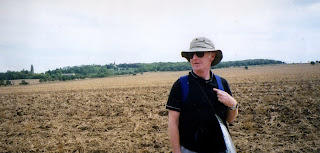
I understand that Stare Vinhorady means Old Vines, but the vineyard has long since disappeared. We were surrounded by a large area of cut corn, with spectacular views of the whole battlefield.

We were fortunate to have another warm sunny afternoon, so we settled down with our picnic lunch, maps and photocopies. As we ate lunch we identified the villages, and the area of the French advance towards Pratzen and Vinhorady.

This was the scene of the fiercest and most critical fighting of the battle. It was held by the Russian Guard who contested possession with Vandamme. The Russian Guard cavalry broke the French left, but Napoleon was at hand to send his own Guard Cavalry in to save the day. The French victory here signaled the end of the battle.

The combination of lovely weather, satisfaction with finding the location and a long picnic lunch whilst reading and imagining what has happened on this very spot all made for an ideal battlefield visit, and one we shall always remember with affection.


Tuesday, 12 April 2011

Telnitz and Sokolnitz


We had previously visited both villages during our 1998 visit to Austerlitz. Although it had been wet and miserable on that earlier visit, it had given us a very good idea of the layout of the area, and made it easy to plan this visit.

After the earlier visit I had bought Scott Bowden’s “Napoleon and Austerlitz”. This excellent book deals with the fighting in some detail, and of particular interest was a section on how the French held villages. The theory was to hold a strong point in the centre, and deploy a skirmish screen facing the enemy. The screen would retire, the strong point would break up the attack, and a strong counter attack would retake the village.

We also relied on Christopher Duffy’s “Austerlitz 1805”. Although it has only 194 pages, as opposed to 520 in Bowden, both are excellent descriptions of the battle. Bowden has lots of technical detail; Duffy is just a really good read. We studied both during our days walk around the villages.

We started at The Pratzen and walked over the fields to Telnitz. We examined the approach and the village itself. It was very hot tramping over the fields, and we had a welcome cold beer in a café near the church.

Then we followed the old track at the back of the village to Sokolnitz. This was the route taken by the French reinforcements who were involved in a “blue on blue” episode, when they were mistaken for an allied attack. We even found a likely spot for this to have happened.

In Sokolnitz we explored the walled garden called the Pheasantry. The walls facing the Pratzen were knocked down to allow the artillery to fire on the attackers, and are now marked with large crosses. We then walked through the village, noting the castle and large barns which would have provided the defence strong points, to the hill behind. It was here that the French defenders rallied and launched their attacks to retake the village.

We spend a couple of hours sitting in the sun on the hill looking down towards Sokolnitz and the Pratzen beyond. We had a bottle of wine and some fruit and we studied our maps and read reports of the fighting. The sun was warm and it was very pleasant. One of those very memorable battlefield visits.

Tuesday, 5 April 2011

The Pratzenberg


Its hard not to compare The Pratzenberg at Austerlitz with The Lion at Waterloo.

Both are large monuments. Both dominate the battlefield. Both are favourite view points for visitors to the battlefield. But whereas The Lion is an artificial mound which destroyed part of the battlefield when it was built, The Pratzenberg seems to be a natural part of the battlefield.

The area around The Pratzenberg has been developed to provide ample parking and a nice park like area for visitors to have a picnic or stretch their legs. There is a small musuem and chapel with a curious echo. The base of the monument contains a crypt containing the scattered human remains which are still found on the battlefield today.

Unlike Waterloo, the are is quiet and respectful. There are none of the garish shops or noisy cafe's. Nor are there noisy coach loads of tourists. Indeed we never saw a single coach in the whole time we were there.

The Pratzenberg was our base for each days visit to the battlefield. We would park our car, gather our haversacks and visit folder and plan our days exploration. From here it is an easy walk to Telnitz, Sokolnitz, Pratzen, Sare Vinoradhy and Augezd. Each well worth at least half a day to explore in full.

More about our visit at

http://walkingaspernausterlitz.blogspot.com/

Tuesday, 29 March 2011

The Santon

Its just a short walk from The Post House to The Santon, for one of the best views of the battlefield.

This small conical hill dominates the whole battlefield. Not because it is particularly high, but rather the battlefield is very flat.

Most visitors make for Zuran Hill, which is signposted from the main road as Napoleons HQ. So we had The Santon to ourselves for the hour or so we spent there. We were fortunate to have a warm afternoon, so it was quite comfortable to sit and read up on the battle. Identifying the main parts of the battlefield form our excellent observation platform.

Tuesday, 22 March 2011

Austerlitz Stara Posta

For our second visit to Austerlitz we stayed at the historic Starra Posta, or Old Post House. It is an important part of the battlefield, both because it was used by both French and allied staff during the battle and as the centre of the annual reenactment battle.

We knew the historic buildings from our earlier visit. There are large stables, where reenactors sleep each year. They are still occupied by horses, as the owner is obviously a keen horse breeder. The restraurant is an original barn, decorated in a style which makes it look like it must have done in 1804. And the main building is now a very interesting museum.

We expected very basic accommodation, and were not prepared for the very modern, and very comfortable, chalet style buildings. They are decorated to the highest standard, and were spotless when we arrived. There is even an underground car park to keep visitors cars out of sight. Though only a few yards from the historic buildings, they are so well concealed that we had not noticied them during our earlier visit.

I would very much recommend a visit, and overnight stay, for anyone visiting the battlefield.

Wednesday, 16 March 2011

Wagram

Markgrafneusiedlung is a small village, which was the extreme left wing of the Austrain army during the battle of Wagram. It was attacked by Marshal Davout, and the scene of desperate hand to hand fighting.

The battlefield is large and very flat, quite similar to Salisbury Plain in UK. So the tower overlooking the village could be seen from most parts of the battlefields, and it served as a marker during the battle.

We spent a day exploring the whole area, and hired bike's for our transport. It had been many years since I last rode a bike, and though I had not forgotten how to ride, I had forgotten how saddle sore you could get. By the time we got to Deutsch Wagram I was riding standing up, because it was too painful to sit on the saddle. And when we walked around the town I did a very reasonable impression of a "John Wayne" walk.

You can read about our visit to Wagram at

http://walkingaspernausterlitz.blogspot.com/


Tuesday, 8 March 2011

The Marchland


The battle of Wagram was fought over a large area of flat farm land, not unlike Salisbury Plain in the UK. There are few proper roads in the area, and those that are don't go where we wanted to go. All of the villages are connected by farm tracks.

Therefore it was not suitable to explore by car. It was too large to explore by foot. It appeared to be ideal to explore by bike. And indeed it was, the problem was that I had not ridden a bike for about 20 years.

The day was warm and sunny, and at the start it was a delight to ride off into the flat expanse of The Marchland. We could go where we wanted, and stop when we wanted. We seemed to have the whole area to ourselves, except for the singing birds.

But it was not long before I was overheating, and getting very saddle sore. Jan was ok, she used a bike to go to work everyday and was leading the way without any idea of just how difficult I was finding it.

We followed the map, and found the main battle areas with ease. The villages were a little disappointing, as they had changed so much since 1809. But we could approach them through the fields, as the infantry had in 1809, and it was easy to imagine what it must have been like then.

By mid afternoon we had drunk all of our water, and were feeling very hot and thirsty. Each village we approached was empty, and all of the shops closed. It was only as we neared Aspern at the end of the afternoon that we finally found a large, and typical German style, pub. We had two huge glasses (steins?) of ice cold beer which we drank in seconds. As we had our second beer we could feel the first one pouring out in sweat!

An excellent day out, and by far the best way to explore this facinating battlefield.

Tuesday, 1 March 2011

Aspern and Essling

It was fortunate that we started our holiday on a Saturday. As soon as we booked in to our hotel we set off to explore the town. Just around the corner was the famous church, with its impressive monument of a wounded lion. Walking around the grounds we came accross a small building with a notice on the door confirming it was a museum and open Sunday morning.

We were waiting for the doors to open at 10am. There were not many visitors, and the lady on the desk was pleased to be able to practice her English. We had planned to visit the Essling Granary after the musuem, and asked her for directions. We were delighted when she told us that there was a small exhibition at the Granary, but it was only open Sunday mornings.

It was almost noon when we arrived at the Granary. We were sad to find it looking very run down and badly in need of renovating. We were the only visitors, and the old boy on the desk seemed less than happy to have two visitors turning up just as he was about to lock up. Despite this he let us in, and allow us to view the large diorama. This was the only exhibit, and we were only allowed in the one large barn like room. Despite his obvious desire for us to leave, we ignored him and took our time viewing the diorama.

Description of our visit at

http://walkingaspernausterlitz.blogspot.com/

Tuesday, 22 February 2011

Lobau Island


We were delighted to discover that our hotel in Aspern was within 100 yards of the famous church, and only about a mile to Lobau Island.

Our bikes were not ready when we arrived at the hotel, so we set off to explore Lobau Island on foot. It was a very hot afternoon, and we were quite warm and glowing by the time we arrived.

We were also very pleased to find that there is a path around the island with these stone plinths to mark important aspects of the 1809 battle. Unfortunately we were not aware of this before our visit, and had not obtained a printed guide - though I am sure that one must exist.

After a couple of hours we reached the river Danube. By now were hot and very tired, and a riverside bar looked very inviting. As we approached we noticed that all of the customers seemed to be very sun bronzed and weathered. We were sitting at the bar before the truth sunk in - we were in a nudist colony!!

Poor Jan did not know where to look. We drank our beer and left in haste.

Wednesday, 16 February 2011

Walking Aspern and Austerlitz


The last of our battlefield walking holidays, at least to date, was in 2002 when we visited Aspern, Essling, Wagram and Austerlitz.

Our first visit to Austerlitz, in 1998, had been spoiled by bad weather. Heavy rain and muddy fields meant that though we walked the area it was not an enjoyable experience. It made us realise that a return visit would be well worth while. But we did not really feel that there was enough to do to keep us busy for a full week.

Aspern-Essling and Wagram are both near Vienna, which in turn is only a few hours drive from Austerlitz. We had never visited these battlefields, and always wanted to. So we decided to do a fly-drive to Vienna. Spend three days exploring Aspern-Essling and Wagram. Drive to Austerlitz and spend another three days exploring there.

After our first visit to Austerlitz I had all the maps I needed. On our return I had read every book I could find, and felt confident that we could explore the battlefield without any further preparation.

On our first visit we had lunch at the Post House in the middle of the battlefield, and I knew that they had excellent accommodation. So we would spend our three days there, in the same building used by the Allied headquarters before the battle and Napoleons headquarters on the night of the battle.

Aspern-Essling and Wagram were a different matter. I had never visited the area, so we would have to research from scratch. The battlefield covered a large area, and would require careful planning to find all the locations. Exploring by car would be difficult, so we decided to hire cycles.

The first blog about our visit deals with the planning, and in particular the books I used to prepare for the visit. It can be found at

http://walkingaspernausterlitz.blogspot.com/